Read This Excerpt From Lorraine Hansberry's a Raisin in the Sun Waits Another Second
| A Raisin in the Sun | |
|---|---|
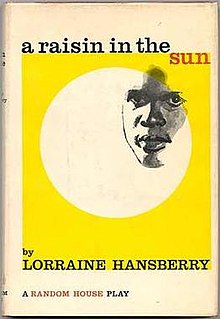 First-edition publication (Random House 1959) | |
| Written by | Lorraine Hansberry |
| Characters |
|
| Date premiered | March 11, 1959 (1959-03-xi) |
| Place premiered | Ethel Barrymore Theatre |
| Original language | English |
| Genre | Domestic drama |
| Setting | Due south Side, Chicago |
A Raisin in the Dominicus is a play by Lorraine Hansberry that debuted on Broadway in 1959.[1] The title comes from the verse form "Harlem" (also known equally "A Dream Deferred"[ii]) by Langston Hughes. The story tells of a Black family's experiences in south Chicago, as they try to improve their financial circumstances with an insurance payout following the decease of the father, and deals with matters of housing discrimination, racism, and absorption. The New York Drama Critics' Circle named it the best play of 1959, and in recent years publications such as The Independent [three] and Time Out [four] take listed it amid the best plays e'er written.
Plot [edit]
Walter and Ruth Younger, their son Travis, along with Walter'due south mother Lena (Mama) and Walter's younger sister Beneatha, live in poverty in a run-down two-bedroom flat on Chicago'south South Side. Walter is barely making a living as a limousine driver. Though Ruth is content with their lot, Walter is non, and badly wishes to become wealthy. His programme is to invest in a liquor shop in partnership with Willy and Bobo, his street-smart acquaintances.
At the start of the play, Walter Lee and Beneatha'south father has recently died, and Mama (Lena) is waiting for a life insurance check for $10,000. Walter has a sense of entitlement to the money, but Mama has religious objections to alcohol, and Beneatha has to remind him it is Mama's call how to spend it. Eventually, Mama puts some of the money down on a new business firm, choosing an all-white neighborhood over a Blackness one for the applied reason that it is much cheaper. Subsequently she relents and gives the remaining $6,500 to Walter to invest, with the provision that he reserve $3,000 for Beneatha's education. Walter gives all of the coin to Willy, who takes it and flees, depriving Walter and Beneatha of their dreams, though non the Youngers of their new home. Bobo reports the bad news most the money. Meanwhile, Karl Lindner, a white representative of the neighborhood they plan to motility to, makes a generous offer to buy them out. He wishes to avert neighborhood tensions over an interracial population, which to the three women's horror Walter bitterly prepares to have every bit a solution to their financial setback. Lena says that while money was something they try to work for, they should never take it if it was a person'south way of telling them they were not fit to walk the same world equally they.
Meanwhile, Beneatha's character and direction in life are influenced by two different men who are potentially love interests: her wealthy and educated swain George Murchison, and Joseph Asagai. Neither man is actively involved in the Youngers' financial ups and downs. George represents the "fully assimilated Black human" who denies his African heritage with a "smarter than thou" mental attitude, which Beneatha finds disgusting, while dismissively mocking Walter'south situation. Joseph, a Yoruba student from Nigeria, patiently teaches Beneatha about her African heritage; he gives her thoughtfully useful gifts from Africa while pointing out she is unwittingly assimilating herself into white ways. She straightens her pilus, for example, which he characterizes as "mutilation".
When Beneatha becomes distraught at the loss of the coin, she is scolded by Joseph for her materialism. She eventually accepts his point of view that things will go amend with effort, along with agreeing to consider his proposal of wedlock and invitation to movement with him to Nigeria to practice medicine.
Walter is oblivious to the stark contrast betwixt George and Joseph: his pursuit of wealth tin can be attained just by liberating himself from Joseph's culture, to which he attributes his poverty, and past ascension to George's level, wherein he sees his salvation. Walter redeems himself and Black pride at the stop by changing his mind and not accepting the buyout offer, stating that the family is proud of who they are and will attempt to be good neighbors. The play closes with the family leaving for their new domicile but uncertain futurity.
The graphic symbol Mrs. Johnson and a few scenes were cutting from the Broadway performance and in reproductions because of fourth dimension constraints. Mrs. Johnson is the Younger family's nosy and loud neighbour, at the beginning of the play. She cannot understand how the family tin can consider moving to a white neighborhood and cattily jokes that she will probably read in the paper in a month that they take been killed in a bombing. Her lines are employed every bit comic relief, but Hansberry also uses this scene to mock those who are also scared to stand for their rights. In the introduction by Robert B. Nemiroff, he writes that the scene is included in print because it draws attention away from a seemingly happy ending to a more violent reality inspired past Hansberry's own experiences.
Broadway production and reception [edit]
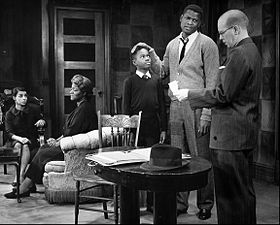
With a cast in which all but ane graphic symbol is Blackness, A Raisin in the Sun was considered a risky investment, and it took eighteen months for producer Philip Rose to enhance enough money to launch it. There was disagreement with how it should be played, with the focus on the mother or on the son. When the play hit New York, Poitier played information technology with emphasis on the son and constitute not only his calling but also an audience enthralled.[5]
After touring to positive reviews, the play premiered on Broadway at the Ethel Barrymore Theatre on March eleven, 1959. It transferred to the Belasco Theatre on October 19, 1959, and closed on June 25, 1960, after 530 total performances. Directed by Lloyd Richards, the cast comprised:
- Sidney Poitier – Walter Lee Younger
- Ruby Dee – Ruth Younger
- Ivan Dixon – Joseph Asagai
- Lonne Elder III – Bobo
- John Fiedler – Karl Lindner
- Louis Gossett – George Murchison
- Claudia McNeil – Lena Younger
- Diana Sands – Beneatha Younger
- Glynn Turman – Travis Younger
- Ed Hall – moving man
- Douglas Turner – moving man
Ossie Davis later took over equally Walter Lee Younger, and Frances Williams equally Lena Younger.
Waiting for the drape to rise on opening night, Hansberry and producer Rose did not expect the play to be a success, for information technology had already received mixed reviews from a preview audition the dark earlier. Though it won pop and disquisitional acclaim, reviewers argued well-nigh whether the play was "universal" or detail to Black experience.[six] It was then produced on tour.
A Raisin in the Sun was the first play written by a Black woman to be produced on Broadway, likewise equally the kickoff with a Black director, Mr. Richards.[7] On opening night, after multiple pall calls, the audition cried out for the author, whereupon Poitier jumped into the audition and pulled Hansberry onto the phase for her ovation.[eight]
Hansberry noted that her play introduced details of Blackness life to the overwhelmingly white Broadway audiences, while director Richards observed that it was the starting time play to which big numbers of Blackness people were drawn.[seven] Frank Rich, writing in The New York Times in 1983, stated that A Raisin in the Sun "changed American theater forever".[9] In 2016, Claire Brennan wrote in The Guardian that "The ability and craft of the writing make A Raisin in the Sun as moving today as it was then."[ten]
In 1960 A Raisin In The Sun was nominated for iv Tony Awards:
- Best Play – written past Lorraine Hansberry; produced past Philip Rose, David J. Cogan
- Best Histrion in Play – Sidney Poitier
- All-time Actress in a Play – Claudia McNeil
- All-time Direction of a Play – Lloyd Richards
West Cease production [edit]
Some v months after its Broadway opening, Hansberry's play appeared in London's Due west End, playing at the Adelphi Theatre from August 4, 1959. Every bit on Broadway, the managing director was Lloyd Richards, and the cast was as follows:
- Kim Hamilton – Ruth Younger
- John Adan – Travis Younger
- Earle Hyman – Walter Lee Younger
- Olga James – Beneatha Younger
- Juanita Moore – Lena Younger
- Bari Johnson – Joseph Asagai
- Scott Cunningham – George Murchison
- Meredith Edwards – Karl Lindner
- Lionel Ngakane – Bobo
The play was presented (as earlier) past Philip Rose and David J. Cogan, in association with the British impresario Jack Hylton.
1961 film [edit]
In 1961, a pic version of A Raisin in the Sun was released featuring its original Broadway cast of Sidney Poitier, Ruby Dee, Claudia McNeil, Diana Sands, Ivan Dixon, Louis Gossett, Jr. and John Fiedler. Hansberry wrote the screenplay, and the film was directed by Daniel Petrie. It was released by Columbia Pictures and Reddish Dee won the National Board of Review Award for Best Supporting Extra. Both Poitier and McNeil were nominated for Aureate World Awards, and Petrie received a special "Gary Cooper Award" at the Cannes Film Festival.
Historical groundwork [edit]
What happens to a dream deferred? Does it dry up like a raisin in the sun?
Langston Hughes (1951)[11]
Experiences in this play echo a lawsuit, Hansberry v. Lee, 311 U.S. 32 (1940), to which the playwright Lorraine Hansberry'due south father was a party, when he fought to take his day in courtroom despite the fact that a previous course action nigh racially motivated restrictive covenants, Burke v. Kleiman, 277 Ill. App. 519 (1934), had been similar to his situation. (This case was heard prior to the passage of the Fair Housing Human action—Championship Viii of the Ceremonious Rights Act of 1968—which prohibited discrimination in housing). The Hansberry family won their correct to exist heard equally a matter of due process of law in relation to the Fourteenth Amendment to the United States Constitution. The Supreme Court held that the Hansberry defendants were non spring by the Burke decision, because the class of homeowners in the Washington Park Subdivision had conflicting goals, and thus could non be considered to exist the same class. The plaintiff in the first activeness in 1934 was Olive Ida Burke, who brought the adjust on behalf of a property owners' association to enforce racial restrictions. Her husband, James Shush, later sold a house to Carl Hansberry (Lorraine'south father), when he changed his mind about the validity of the covenant. Mr. Burke'southward conclusion may take been motivated by the changing demographics of the neighborhood, but it was also influenced past the Depression. The demand for houses was and so low amongst white buyers that Mr. Hansberry may take been the simply prospective purchaser available.[12]
Other versions [edit]
1973 musical [edit]
A musical version of the play, Raisin, ran on Broadway from October 18, 1973, to December 7, 1975. The book of the musical, which stayed close to the play, was written past Hansberry's sometime husband, Robert Nemiroff. Music and lyrics were by Judd Woldin and Robert Brittan. The cast included Joe Morton (Walter Lee), Virginia Capers (Mama), Ernestine Jackson (Ruth), Debbie Allen (Beneatha) and Ralph Carter (Travis, the Youngers' young son). The show won the Tony Award for Best musical.
1989 Telly film [edit]
In 1989, the play was adapted into a Idiot box motion picture for PBS's American Playhouse series, starring Danny Glover (Walter Lee) and Esther Rolle (Mama), with Kim Yancey (Beneatha), Starletta DuPois (Ruth), and John Fiedler (Karl Lindner), with Helen Martin reprising her part as Mrs. Johnson. This product received three Emmy Accolade nominations, only all were for technical categories. Bill Knuckles directed the product, while Chiz Schultz produced. This product was based on an off-Broadway revival produced by the Roundabout Theatre.
1996 BBC Radio play [edit]
On 3 March 1996, the BBC broadcast a product of the play past director/producer Claire Grove, with the post-obit cast:[13]
- Claire Benedict – Mama
- Ray Shell – Walter Lee
- Pat Bowie – Ruth
- Lachelle Carl – Beneatha
- Garren Givens – Travis
- Akim Mogaji – Joseph Asagai
- Ray Fearon – George Murchison
- John Sharion – Karl Lindner
- Dean Hill – Bobo
Broadway revival, 2004 [edit]
A revival ran on Broadway at the Royale Theatre from Apr 26, 2004, to July 11, 2004[14] with the post-obit cast:
- Sean Combs – Walter Lee Younger
- Audra McDonald – Ruth Younger
- Phylicia Rashad – Lena Younger
- Sanaa Lathan – Beneatha Younger
- Beak Nunn – Bobo
- David Aaron Baker – Karl Lindner
- Lawrence Ballard – moving man
- Teagle F. Bougere – Joseph Asagai
- Frank Harts – George Murchison
- Billy Eugene Jones – moving man
- Alexander Mitchell – Travis Younger
The director was Kenny Leon, and David Binder and Vivek Tiwary were producers.
The play won 2 2004 Tony Awards: Best Actress in a Play (Phylicia Rashad) and Best Featured Extra in a Play (Audra McDonald), and was nominated for Best Revival of a Play and All-time Featured Actress in a Play (Sanaa Lathan).
2008 Television receiver film [edit]
In 2008, Sean Combs, Phylicia Rashad, Audra McDonald, and Sanaa Lathan reprised their roles from the 2004 Broadway revival in a television film directed by Kenny Leon. The film debuted at the 2008 Sundance Film Festival and was broadcast by ABC on February 25, 2008. Rashad and McDonald received Emmy nominations for their portrayals of Lena and Ruth.[15] According to Nielsen Media Research, the program was watched by 12.seven million viewers and ranked No. 9 in the ratings for the week catastrophe March two, 2008.[sixteen]
Purple Substitution, Manchester production, 2010 [edit]
In 2010, Michael Buffong directed a widely acclaimed production at the Purple Commutation Theatre in Manchester,[17] described past Dominic Cavendish in The Daily Telegraph equally "A brilliant play, brilliantly served".[18] Michael Buffong, Ray Fearon and Jenny Jules all won MEN Awards. The cast were:
- Jenny Jules – Ruth Younger
- Ray Fearon – Walter Lee Younger
- Tracy Ifeachor – Beneatha Younger
- Starletta DuPois (who played Ruth in the 1989 film) – Lena Younger
- Damola Adelaja – Joseph Asagai
- Simon Combs – George Murchison
- Tom Hodgkins – Karl Lindner
- Ray Pismire Chocolate-brown – Bobo/Moving Man
Broadway revival, 2014 [edit]
A second revival ran on Broadway from April 3, 2014, to June 15, 2014, at the Ethel Barrymore Theatre.[nineteen] [xx] The play won three 2014 Tony Awards: Best Revival of a Play, All-time Operation past an Actress in a Featured Office in a Play (Sophie Okonedo) and All-time Direction of a Play (Kenny Leon).[21]
- Denzel Washington – Walter Lee Younger
- Sophie Okonedo – Ruth Younger
- LaTanya Richardson Jackson – Lena Younger
- Anika Noni Rose – Beneatha Younger
- Stephen McKinley Henderson – Bobo
- David Cromer – Karl Lindner
- Keith Eric Chappelle – moving human being
- Sean Patrick Thomas – Joseph Asagai
- Jason Dirden – George Murchison
- Billy Eugene Jones – moving man
- Bryce Clyde Jenkins – Travis Younger
2016 BBC Radio Play [edit]
On 31 Jan 2016 the BBC broadcast a new product of the play by manager/producer Pauline Harris. This version restores the character of Mrs Johnson and a number of scenes that were cut from the Broadway production and subsequent moving-picture show, with the following bandage:[22]
- Danny Sapani – Walter Lee Younger
- Dona Croll – Lena Younger
- Nadine Marshall – Ruth Younger
- Lenora Crichlow – Beneatha Younger
- Segun Fawole – Travis Younger
- Jude Akwudike – Bobo/Asagai
- Cecilia Noble – Mrs. Johnson
- Sean Baker – Karl Lindner
- Richard Pepple – George Murchinson
Arena Stage revival, 2017 [edit]
The play opened on April half-dozen, 2017, at Arena Stage in Washington, D.C., directed by Tazewell Thompson, with the following cast:[23]
- Will Cobbs – Walter Lee Younger
- Lizan Mitchell – Lena Younger
- Dawn Ursula – Ruth Younger
- Joy Jones – Beneatha Younger
- Jeremiah Jerky – Travis Younger
- Mack Leamon – Bobo/Asagai
- Thomas Adrian Simpson – Karl Lindner
- Keith 50. Royal Smith – George Murchinson
The Raisin Cycle [edit]
The 2010 Bruce Norris play Clybourne Park depicts the white family unit that sold the house to the Youngers. The showtime act takes place just before the events of A Raisin in the Sunday, involving the selling of the house to the Black family; the second act takes place l years after.[24]
The 2013 play by Kwame Kwei-Armah entitled Beneatha's Place follows Beneatha after she leaves with Asagai to Nigeria and, instead of condign a doctor, becomes the Dean of Social Sciences at a respected (unnamed) California academy.[25]
The two to a higher place plays, together with the original, were referred to by Kwei-Armah as "The Raisin Cycle" and were produced together past Baltimore'due south Center Stage in the 2012–2013 season.[26]
See also [edit]
- Ceremonious rights move in popular culture
References [edit]
- ^ Internet Broadway Database. "A Raisin in the Dominicus | Ethel Barrymore Theatre (3/11/1959 – x/17/1959)". IBDB. Archived from the original on 2013-12-25. Retrieved 2014-01-07 .
- ^ "A Dream Deferred (by Langston Hughes)". Cswnet.com. 1996-06-25. Archived from the original on 2014-01-08. Retrieved 2014-01-07 .
- ^ "The 40 best plays to read before you die". The Independent. 2019-08-eighteen. Retrieved 2020-04-xvi .
- ^ "l Best Plays of All Time: Comedies, Tragedies and Dramas Ranked". Fourth dimension Out New York . Retrieved 2020-04-16 .
- ^ Poitier, Sidney (2000). The Mensurate of a Human being (kickoff ed.). San Francisco: Harper. pp. 148–158. ISBN978-0-06-135790-9.
- ^ Bernstein, Robin (1999). "Inventing a Fishbowl: White Supremacy and the Critical Reception of Lorraine Hansberry's A Raisin in the Lord's day". Modern Drama. 42 (1): sixteen–27. doi:10.3138/md.42.1.sixteen. Archived from the original on 2010-07-09. Retrieved 2011-04-fourteen .
- ^ a b Corley, Cheryl, "'A Raisin in the Dominicus', Present at the Creation" Archived 2017-07-04 at the Wayback Machine, National Public Radio, March 11, 2002.
- ^ McGreevy, Nora. "How Sidney Poitier Rewrote the Script for Black Actors in Hollywood". Smithsonian Magazine.
- ^ Rich, Frank (October 5, 1983). "Theater: 'Raisin in Sun,' Anniversary in Chicago". The New York Times. Archived from the original on 2016-06-21. Retrieved 2018-03-22 .
- ^ Brennan, Claire (February 7, 2016). "A Raisin in the Sunday review – notwithstanding challenging its characters and audition". The Guardian. Archived from the original on 2018-02-24. Retrieved 2018-02-25 . Review of a revival in Sheffield, England.
- ^ "Transcript: Langston Hughes and His Poetry – presentation by David Kresh (Journeys and Crossings, Library of Congress)". www.loc.gov. Archived from the original on 2017-05-26. Retrieved 29 April 2017.
- ^ Kamp, Allen R. "The History Behind Hansberry v. Lee," twenty U.Southward. Davis Fifty. Rev. 481 (1987).
- ^ "A Raisin in the Sun". Archived from the original on 2017-03-23. Retrieved 2017-03-23 .
- ^ Internet Broadway Database. "A Raisin in the Sun | Royale Theatre (iv/26/2004 – 7/11/2004)". IBDB. Archived from the original on 2014-01-07. Retrieved 2014-01-07 .
- ^ "Chenoweth, Dench, Linney, McDonald, Rashad Nominated for Emmy Awards". Playbill. Archived from the original on 2012-x-25.
- ^ Ginia Bellafante, "Raisin in the Sun: A Tale of Race and Family and a $10,000 Question" Archived 2017-03-ten at the Wayback Machine, The New York Times, Feb 25, 2008.
- ^ "A Raisin in the Sun". The Guardian. Archived from the original on 2016-09-26. Retrieved 2016-09-24 .
- ^ "A Raisin in the Sunday review". The Daily Telegraph. Archived from the original on 2016-ten-09. Retrieved 2016-09-24 .
- ^ Playbill Vault. "A Raisin in the Sun". Playbill Vault. Archived from the original on 2014-04-05. Retrieved 2014-05-05 .
- ^ Gioia, Michael. "Tony-Winning Revival of 'A Raisin in the Sun' Plays Last Operation Tonight" playbill.com, June 15, 2014
- ^ Purcell, Carey. "'Gent'due south Guide', 'All The Manner', 'Hedwig And the Aroused Inch', 'Raisin in the Sun 'Win Height Prizes at 68th Annual Tony Awards" Archived 2014-06-12 at the Wayback Machine playbill.com, June 8, 2014
- ^ [1] Archived 2016-02-06 at the Wayback Automobile, BBC, Jan 31, 2016.
- ^ "Archived re-create". Archived from the original on 2017-04-08. Retrieved 2017-04-08 .
{{cite web}}: CS1 maint: archived re-create every bit title (link) - ^ Brantley, Ben, "Practiced Defenses Brand Good Neighbors," The New York Times, Feb 22, 2010.
- ^ Paul Harris, Legit Review: 'Beneatha'south Identify', [ii] Archived 2017-12-05 at the Wayback Machine
- ^ David Zurawik, "Baltimore'due south Middle Stage looks very good in PBS documentary on 'Raisin' cycle", The Baltimore Sun, October 25, 2013, [3] Archived 2014-10-06 at the Wayback Machine
External links [edit]
- A Raisin in the Dominicus at the Internet Broadway Database
- A Raisin in the Sun at Theatricalia.com
- Listen to the play online
- EDSITEment'southward lesson Raisin in the Sunday the Quest for the American Dream
- Text to Text: ''A Raisin in the Sun'' and ''Bigotry in Housing Against Nonwhites Persists Quietly'' from The New York Times
Source: https://en.wikipedia.org/wiki/A_Raisin_in_the_Sun
0 Response to "Read This Excerpt From Lorraine Hansberry's a Raisin in the Sun Waits Another Second"
Post a Comment